I'm a participant in the Amazon Services LLC Associates Program, an affiliate advertising program designed to provide a means for me to earn fees by linking to Amazon.com and affiliated sites.
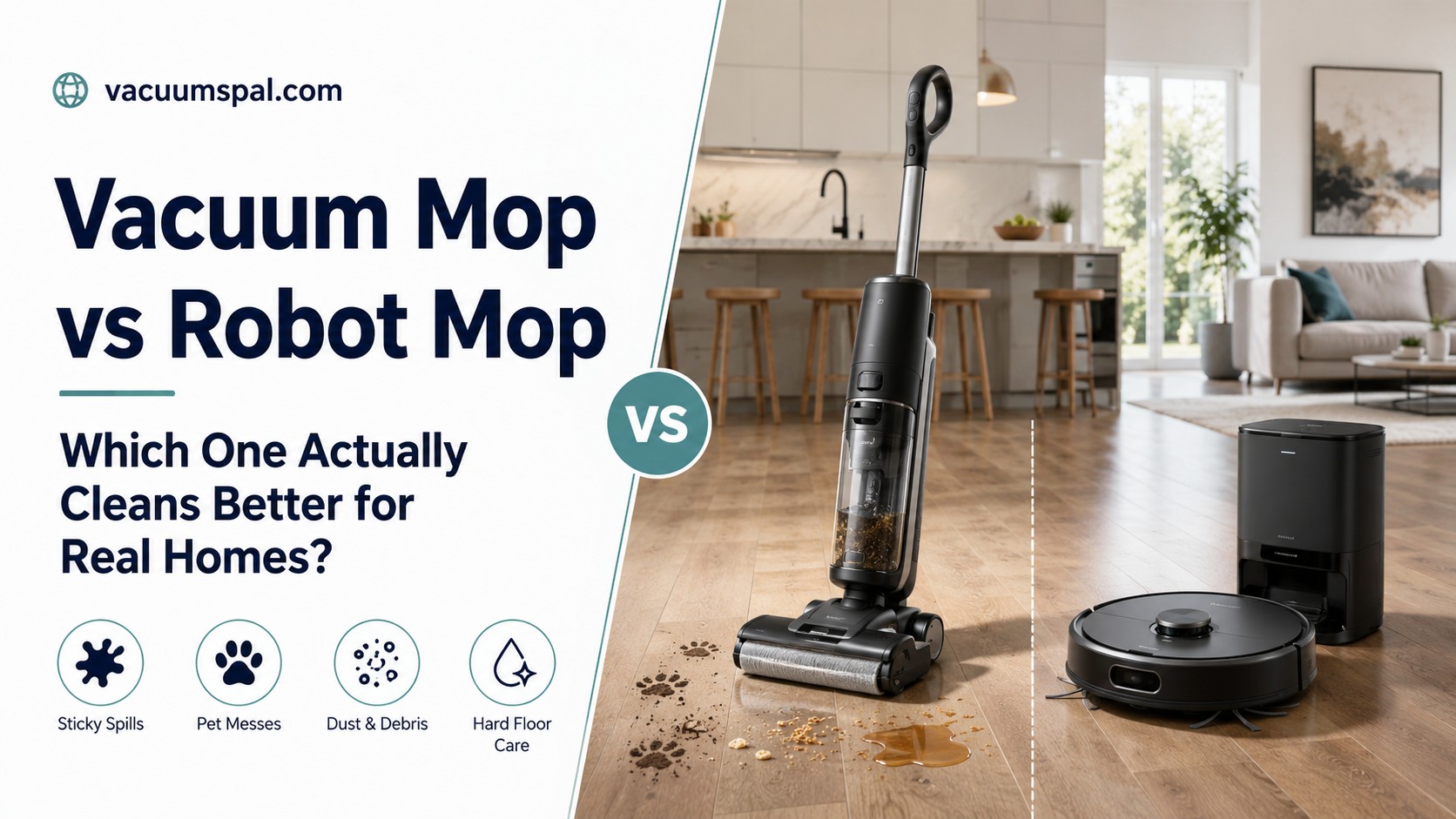
A vacuum mop and a robot mop both promise cleaner floors with less work, but they are not the same kind of cleaning tool.
A vacuum mop is usually an upright wet-dry floor cleaner. You push it like a vacuum, and it vacuums dry debris while washing the floor with clean water or cleaning solution. It is best for real messes: spills, sticky kitchen floors, muddy paw prints, food drops, pet accidents, and dried-on grime.
A robot mop is usually a robot vacuum-mop combo. It drives around by itself, vacuums, wipes or scrubs the floor, and returns to a dock. Premium models can wash and dry their own mop pads. Robot mops are best for maintenance cleaning: daily dust, light footprints, pet hair, and keeping hard floors from getting dirty so fast.
So, which one actually cleans better?
For real messes, a vacuum mop cleans better. For daily maintenance with less effort, a robot mop is easier to live with.
Quick Verdict
- Choose a vacuum mop for real spills, sticky messes, pet accidents, muddy paw prints, and kitchen floors. A wet-dry vacuum mop gives you more cleaning control, stronger liquid pickup, and better scrubbing pressure because you are physically guiding it over the mess.
- Choose a robot mop for maintenance cleaning. A robot mop is better for keeping floors lightly cleaned every day, especially if your home has mostly hard floors and you want automated cleaning while you do other things.
- Do not expect a robot mop to replace deep cleaning. This is the biggest mistake people make. Even a good robot mop is mostly a maintenance tool, not a full replacement for a wet-dry vacuum mop, steam mop, scrub brush, or hands-on floor cleaning.
The Short Answer
If your floor is already dirty, choose a vacuum mop.
If your floor gets lightly dusty every day and you want help keeping up, choose a robot mop.
A vacuum mop is better when you need to clean something now. A robot mop is better when you want your floors to stay cleaner between real cleaning sessions.
For many homes, the best setup is both: a robot mop for daily maintenance and a vacuum mop for weekly deeper cleaning or sudden messes.
Vacuum Mop vs Robot Mop: Simple Comparison Table
Mess or Situation | Better Choice | Why |
|---|---|---|
Sticky kitchen spills | Vacuum mop | More pressure, more liquid pickup, better control |
Muddy paw prints | Vacuum mop | Handles wet dirt and visible grime better |
Pet accidents | Vacuum mop, with caution | You need direct control and immediate cleanup |
Daily dust | Robot mop | Can run automatically on a schedule |
Light footprints | Robot mop | Good for maintenance wiping |
Crumbs and wet spills together | Vacuum mop | Vacuums and washes in one manual pass |
Pet hair on hard floors | Robot mop for maintenance, vacuum mop for mixed messes | Robot helps daily, vacuum mop helps when hair mixes with wet grime |
Toddlers dropping food | Vacuum mop | Better for food bits, juice, cereal, and sticky residue |
Apartments | Depends | Robot mop for convenience, vacuum mop for one-device cleaning |
Hardwood floors | Depends on floor safety | Use gentle settings and avoid too much water |
Tile and grout | Vacuum mop for cleaning, robot mop for upkeep | Tile can benefit from stronger scrubbing |
Seniors | Robot mop for less pushing, vacuum mop for faster visible results | Depends on strength, storage, and comfort |
Area rugs | Robot vacuum-mop combo or separate vacuum | Most vacuum mops are not deep carpet cleaners |
Deep cleaning | Vacuum mop | More direct cleaning power |
Set-it-and-forget-it cleaning | Robot mop | Automation is the main advantage |
What Is a Vacuum Mop?
A vacuum mop is a wet-dry floor cleaner that vacuums and washes hard floors at the same time.
Most models look like upright cordless vacuums. You push the machine across the floor, and it uses a spinning brush roll, clean water tank, dirty water tank, and suction system to pick up debris and dirty water.
Some popular vacuum mop styles include:
- Bissell CrossWave-style wet-dry cleaners
- Tineco Floor One models
- Dreame H-series wet-dry vacuums
- Roborock wet-dry floor cleaners
- Shark HydroVac-style cleaners
- Hoover wet-dry floor cleaners
The main benefit is simple: you control the cleaning.
You can move slowly over a sticky spot, make extra passes, focus on corners, clean under the kitchen table, and immediately handle a spill. That direct control is why vacuum mops usually clean better than robot mops when the floor is truly dirty.
What vacuum mops are best at
Vacuum mops are best for:
- kitchen spills
- sticky floors
- muddy footprints
- pet bowl areas
- food crumbs and wet messes
- toddler messes
- dried splashes
- entryways
- bathroom floors
- tile
- sealed hard floors
- fast visible results
A vacuum mop is the machine you grab when you look at the floor and think, “This actually needs cleaning.”
What vacuum mops are not good at
A vacuum mop is not perfect.
Most vacuum mops are not ideal for:
- thick carpet
- stairs
- delicate unsealed wood
- large dry-only debris piles
- upholstery
- deep grout restoration
- cleaning without any maintenance
- people who cannot comfortably push a wet-dry machine
Vacuum mops also need cleanup after use. You usually need to empty the dirty water tank, rinse parts, clean or dry the brush roll, refill clean water, and occasionally clean filters or suction channels.
Premium models reduce this work with self-cleaning and drying, but they do not remove maintenance completely.
What Is a Robot Mop?
A robot mop is usually a robot vacuum-mop combo that can vacuum and mop hard floors automatically.
Some use a simple damp pad. Others use vibrating mop plates, spinning mop pads, roller mops, mop-lifting systems, auto-refilling docks, hot-water mop washing, hot-air drying, detergent tanks, dirt detection, and automatic re-mopping.
Premium robot mops have improved a lot. The best ones are much more useful than older robots that simply dragged a wet cloth behind them.
But the main purpose is still different from a vacuum mop.
A robot mop is not mainly for disaster cleanup. It is for regular maintenance.
What robot mops are best at
Robot mops are best for:
- daily dust
- light footprints
- small amounts of pet hair
- light kitchen maintenance
- keeping tile fresh
- keeping hardwood looking cleaner
- scheduled cleaning
- cleaning while you work or sleep
- homes with mostly hard floors
- people who hate daily sweeping
- people who want automation
A robot mop is the machine you use so the floor does not get dirty as quickly.
What robot mops are not good at
Robot mops are not ideal for:
- large spills
- sticky dried messes
- pet accidents
- heavy mud
- thick food messes
- deep grout cleaning
- cluttered floors
- uneven thresholds
- homes with lots of rugs
- floors that need direct scrubbing pressure
Some premium robot mops can handle more than older models, but they still cannot see and judge messes like a person. They may avoid a mess, smear a mess, miss a spot, or fail to apply enough pressure.
Which One Actually Cleans Better?
A vacuum mop cleans better when the mess is real.
That is the simplest answer.
A vacuum mop has three big advantages:
- You control where it goes.
- You can apply more pressure and repeated passes.
- It can suck up dirty liquid and debris immediately.
A robot mop has one big advantage:
- It cleans automatically and often.
That means the “better” choice depends on what you mean by clean.
If you mean remove a sticky spill from the kitchen floor, the vacuum mop wins.
If you mean keep the floor looking decent all week with little effort, the robot mop wins.
Cleaning power winner
For actual cleaning power: Vacuum mop
Convenience winner
For daily convenience: Robot mop
Best long-term setup
For the cleanest home with the least stress: Robot mop plus vacuum mop
Vacuum Mop vs Robot Mop by Mess Type
Sticky kitchen spills
Winner: Vacuum mop
Sticky kitchen messes are one of the clearest wins for vacuum mops.
Think of:
- syrup
- juice
- sauce
- egg
- cereal milk
- rice
- oatmeal
- coffee with sugar
- greasy cooking residue
- dried food drops
A robot mop may help with light residue, especially if it has spinning pads or a roller mop. But when something is sticky, you usually need direct pressure, repeated passes, and immediate dirty-water pickup.
A vacuum mop lets you slow down and work the area until the floor feels clean.
Muddy paw prints
Winner: Vacuum mop
Robot mops can help with light paw prints if they run regularly. But for real mud, a vacuum mop is better.
Mud is a mixed mess. It has water, dirt, grit, and sometimes pet hair. A robot mop may spread some of that around before it fully lifts it.
A vacuum mop can wash and suction it up in a more controlled way.
Pet accidents
Winner: Vacuum mop, but clean carefully
A robot mop should not be your first choice for pet accidents.
If there is any solid waste or heavy mess, do not let a robot run over it. That can spread the mess across the floor and into the robot.
A vacuum mop gives you more control, but even then, you should handle pet accidents carefully. Pick up solids first, use an appropriate cleaner for the floor and mess, and clean the machine thoroughly afterward.
For pet accidents on carpet or rugs, use a carpet cleaner or spot cleaner, not a standard vacuum mop or robot mop.
Dry crumbs
Winner: Depends
For dry crumbs, a robot vacuum-mop combo can be very useful if it has good vacuuming performance. It can pick up crumbs on a schedule without you doing anything.
But if the crumbs are mixed with a wet spill, a vacuum mop is better.
For example:
- dry cereal on the floor: robot can help
- cereal plus milk: vacuum mop wins
- dry rice: either can work
- rice plus sauce: vacuum mop wins
Pet hair
Winner: Robot mop for daily maintenance, vacuum mop for mixed messes
Pet hair is tricky because it is often dry, but it can mix with water, mud, litter, or food.
A robot vacuum-mop combo is excellent for daily pet hair control on hard floors. It can run every day and prevent fur from collecting in corners.
A vacuum mop is better when pet hair is mixed with wet messes, dirty paw prints, or food spills.
For pet hair on carpet, neither a robot mop nor a vacuum mop is the best answer. Use a robot vacuum for maintenance and a full-size vacuum for deeper cleaning.
Baby and toddler food messes
Winner: Vacuum mop
Toddlers create the exact kind of messes vacuum mops are built for.
A robot mop is not ideal for:
- applesauce
- yogurt
- cereal and milk
- dropped pasta
- juice
- sticky finger marks
- smashed fruit
- high-chair splatter
A vacuum mop is better because you can clean the mess right away and make several passes over the exact area.
Light daily dust
Winner: Robot mop
This is where robot mops shine.
If the floor is not visibly dirty but gets dusty every day, a robot mop can help maintain it with almost no effort. It can run while you are working, sleeping, or out of the house.
A vacuum mop can also clean dust, but using it every day may feel like too much work.
Deep cleaning
Winner: Vacuum mop
A robot mop is not a deep cleaner.
Premium robot mops are better than older models, but they are still limited by their weight, water use, pad pressure, and ability to judge stains.
A vacuum mop is better for deeper hard-floor cleaning because you are guiding it and can spend more time where the floor is dirty.
Best for Kitchens
Winner: Vacuum mop
For kitchens, the vacuum mop is the better cleaning tool.
Kitchens get the most mixed messes in the house. Crumbs, grease, sticky spills, coffee, sauce, juice, pet food, and food prep debris can all end up on the same floor.
A robot mop can help maintain the kitchen if it runs daily, but it should not be your main tool for real kitchen spills.
Choose a vacuum mop for kitchens if:
- you cook often
- you have kids
- you have pets
- sticky messes happen often
- you want fast cleanup after meals
- your kitchen floor gets greasy
- you want to vacuum and wash in one pass
Choose a robot mop for kitchens if:
- your messes are mostly light
- you want daily maintenance
- you already wipe up big spills by hand
- you want the floor to look cleaner between deeper cleans
Best kitchen setup: robot mop for daily maintenance, vacuum mop for after cooking or spills.
Best for Pets
Winner: Depends on the pet mess
For pets, the best choice depends on what kind of mess your pet creates.
Choose a robot mop for pets if:
- your main problem is daily fur on hard floors
- your pet tracks light dust
- you want cleaning while you are out
- you want to reduce hair buildup
- your floor is usually clear of pet toys and accidents
Choose a vacuum mop for pets if:
- your pet tracks mud
- you clean around water bowls
- pet food gets wet or sticky
- there are paw prints near doors
- you need to clean messes immediately
- you want stronger floor washing
For many pet homes, a robot vacuum-mop combo is great for daily fur control, but a vacuum mop is still needed for muddy paw prints and wet messes.
Important pet warning
Do not let a robot mop run unattended if your pet sometimes has accidents. A robot can spread a mess and contaminate its brush, wheels, mop pad, and dock.
If pet accidents are a real concern, choose a robot with strong obstacle avoidance, but still be cautious.
Best for Toddlers and Kids
Winner: Vacuum mop
For toddlers, a vacuum mop is the better choice.
Kids create sticky, chunky, and unpredictable messes. A robot mop may help with daily maintenance, but it is not the right tool for immediate food cleanup.
A vacuum mop works better around:
- high chairs
- snack areas
- playrooms with hard floors
- juice spills
- sticky footprints
- cereal
- fruit
- pasta
- craft messes
A robot mop is still useful after the main cleanup is done. It can run daily to keep dust and crumbs from building up.
But when a toddler drops yogurt on the floor, you want a vacuum mop, not a robot.
Best for Apartments
Winner: Depends on space and budget
Apartments can go either way.
A robot mop is appealing because it saves time and can clean while you do other things. But a vacuum mop may be more practical if you have limited storage and want one tool that handles visible messes quickly.
Choose a robot mop for an apartment if:
- you have mostly hard floors
- your floor plan is simple
- you hate daily sweeping
- you have room for the dock
- you want cleaning while you are out
- you do not have many loose cords or rugs
Choose a vacuum mop for an apartment if:
- you have a small kitchen
- you want one affordable cleaner
- you do not want a large robot dock
- you have pets
- you clean spills often
- you want immediate visible results
For small apartments, a vacuum mop may offer better value. For larger apartments with mostly hard floors, a robot mop can be worth it.
Best for Hardwood Floors
Winner: Depends on floor type
Hardwood floors require caution.
Both vacuum mops and robot mops use water. Too much water, steam, or cleaning solution can damage some wood floors, especially if they are unsealed, worn, scratched, or have gaps.
For hardwood, the best choice is the one that uses controlled moisture and does not leave water sitting on the floor.
Vacuum mop for hardwood
A vacuum mop can work well on sealed hardwood if the machine is designed for sealed hard floors and you use the correct cleaning mode.
The advantage is that it picks up dirty water quickly.
The risk is using too much water or moving too slowly in one spot.
Robot mop for hardwood
A robot mop can work well for light maintenance on sealed hardwood because it usually uses less water than a full manual mopping session.
The advantage is frequent light cleaning.
The risk is that it may repeatedly mop areas you would rather keep dry, or it may drag a damp pad over sensitive areas.
Hardwood recommendation
For sealed hardwood with light daily dust, choose a robot mop.
For sticky messes on sealed hardwood, choose a vacuum mop and dry the area if needed.
Avoid steam unless your flooring manufacturer clearly says steam is safe.
Best for Tile
Winner: Vacuum mop for cleaning, robot mop for maintenance
Tile is more forgiving than hardwood, so both tools can work well.
A vacuum mop is better for kitchen tile, bathroom tile, muddy entryways, and sticky messes.
A robot mop is better for keeping tile looking clean between deeper cleanings.
Choose a vacuum mop for tile if:
- grout gets dirty
- kitchen spills happen often
- there are muddy footprints
- you want deeper cleaning
- you need stronger scrubbing
Choose a robot mop for tile if:
- you want daily maintenance
- the floor mostly gets dusty
- you want automatic cleaning
- you do not want to mop often
If your tile has deep grout lines, neither tool may fully replace occasional grout scrubbing.
Best for Seniors
Winner: Robot mop for less physical effort, vacuum mop for faster visible cleanup
This depends on the person.
A robot mop is easier because it does the moving for you. That can be helpful for seniors who have trouble pushing a machine, bending, or cleaning often.
A vacuum mop is better if the person wants a simple, direct machine that cleans visible messes quickly.
Robot mop may be better for seniors if:
- pushing a vacuum is tiring
- daily cleaning is difficult
- the home has mostly hard floors
- the floor stays fairly uncluttered
- app setup is not a problem
- someone can help with dock maintenance
Vacuum mop may be better for seniors if:
- they dislike apps
- they want immediate control
- they have a small kitchen or apartment
- they can comfortably push the machine
- they do not want a robot dock
- they want to see the mess being cleaned
The biggest issue is maintenance. Robot mops reduce pushing, but premium docks still need water changes, dirty tank emptying, bag replacement, and occasional cleaning.
For seniors, the best choice is the one that reduces the most difficult part of cleaning, not necessarily the most advanced machine.
The Mistake People Make: Expecting a Robot Mop to Replace Deep Cleaning
The biggest mistake people make is expecting a robot mop to replace deep cleaning.
A robot mop is not a human with a mop bucket. It cannot look at a sticky stain and decide to scrub harder. It cannot lift chair legs, move clutter, clean baseboards, rinse itself by hand, or judge whether a spill needs special treatment.
Even premium robot mops have limits.
They are best at light, frequent cleaning. That is valuable, but it is not the same as deep cleaning.
What a robot mop can realistically do
A good robot mop can:
- reduce dust buildup
- wipe light footprints
- help with daily pet hair
- keep tile or hardwood looking fresher
- clean on a schedule
- reduce how often you manually mop
- maintain floors between deeper cleanings
What a robot mop cannot reliably do
A robot mop cannot reliably:
- clean big spills
- scrub dried sticky messes
- handle pet accidents safely
- deep clean grout
- replace a wet-dry vacuum mop
- clean stairs
- clean cluttered floors
- replace human judgment
A robot mop is a maintenance helper. If you see it that way, it can be excellent. If you expect it to replace all floor cleaning, you will likely be disappointed.
Robot Mop vs Wet Dry Vacuum: Which Is Easier?
A robot mop is easier during cleaning. A wet-dry vacuum mop is easier when you need results right now.
Robot mop ease
A robot mop is easier because it can run automatically. You can schedule it, send it to rooms, and let it clean while you do something else.
But robot mops still require setup and maintenance:
- mapping the home
- setting no-go zones
- clearing cords and clutter
- refilling clean water
- emptying dirty water
- washing or replacing mop pads
- cleaning the dock
- replacing bags and filters
Premium docks help, but they do not eliminate the work.
Vacuum mop ease
A vacuum mop requires you to push it. That is more physical effort.
But it is simple. You see a mess, you clean it, and you are done.
Maintenance is also more direct:
- empty dirty water
- rinse the tank
- run self-cleaning if available
- dry or replace the brush roll
- refill clean water when needed
A vacuum mop takes more effort during cleaning but may feel more predictable.
Which One Saves More Time?
This depends on your cleaning routine.
A robot mop saves more time over the week because it can clean automatically. It is especially useful if you run it daily or every other day.
A vacuum mop saves more time during a specific mess because it handles dry and wet debris in one manual pass.
Robot mop saves time when:
- you run it on a schedule
- your floors are mostly clear
- your home has a simple layout
- you use no-go zones correctly
- you want maintenance cleaning
Vacuum mop saves time when:
- there is a spill
- the kitchen floor is sticky
- pets tracked in mud
- kids made a food mess
- you need one quick cleaning session
For busy homes, the best answer is often robot mop for routine cleaning and vacuum mop for urgent messes.
Which One Is Better for Pet Hair?
For dry pet hair on hard floors, a robot vacuum-mop combo can be very helpful.
It can run daily and keep fur from collecting under tables, near couches, along baseboards, and around pet beds.
For pet hair mixed with wet dirt, food, water, or mud, a vacuum mop is better.
Best choice by pet mess
Pet Mess | Better Choice |
|---|---|
Daily fur on hard floors | Robot mop or robot vacuum-mop |
Fur on rugs | Robot vacuum or full-size vacuum |
Muddy paw prints | Vacuum mop |
Wet pet food | Vacuum mop |
Litter tracking | Robot vacuum-mop for maintenance, vacuum mop for mixed messes |
Water bowl splashes | Vacuum mop |
Pet accidents | Manual cleanup first, then appropriate cleaner |
Pet homes often benefit from both tools, especially if the home has hard floors and shedding pets.
Which One Is Better for Sticky Floors?
The vacuum mop is better for sticky floors.
Sticky floors need moisture, pressure, and dirty-water pickup. A robot mop may improve the floor, but it may not fully remove the residue.
This matters most in kitchens, dining rooms, and homes with kids.
If your socks stick to the floor, use a vacuum mop.
If the floor just looks a little dusty, use a robot mop.
Which One Is Better for Daily Cleaning?
The robot mop is better for daily cleaning.
Most people will not push a vacuum mop every single day. A robot mop can run automatically and keep floors from getting bad in the first place.
That is the true value of a robot mop. It changes cleaning from a big chore into a background routine.
A vacuum mop is better for intentional cleaning sessions. A robot mop is better for ongoing maintenance.
Which One Is Better If You Have Mostly Hard Floors?
If your home has mostly hard floors, both can be useful.
Choose a robot mop if you want the floors maintained daily.
Choose a vacuum mop if you want stronger cleaning when the floors are visibly dirty.
Mostly hard floors recommendation
Best convenience: Robot mop
Best cleaning power: Vacuum mop
Best setup: Both
If you can only buy one, choose based on your messes. Sticky messes mean vacuum mop. Dusty floors mean robot mop.
Which One Is Better If You Have Mostly Carpet?
If your home has mostly carpet, neither a vacuum mop nor a robot mop should be your main cleaning tool.
You need a good vacuum first.
A robot vacuum can help maintain carpet, but the mop feature will not matter much. A vacuum mop is mostly for hard floors and should not be used as a carpet cleaner.
Mostly carpet recommendation
Buy in this order:
- Full-size vacuum or strong cordless vacuum
- Robot vacuum for maintenance
- Spot cleaner for stains
- Vacuum mop only if you also have hard floors
Do not buy a robot mop mainly for a carpeted home.
What to Look for in a Vacuum Mop
If you choose a vacuum mop, look for practical features, not just marketing claims.
Strong dirty-water pickup
A good vacuum mop should leave the floor damp, not wet. If it leaves too much water behind, it can be annoying and risky for wood floors.
Self-cleaning
Self-cleaning is very useful. It rinses the brush roll and internal path after cleaning.
It does not replace all maintenance, but it helps.
Brush drying
Brush drying is even better. Wet brush rolls can smell if they sit damp for too long.
Premium models with hot-air drying are easier to live with.
Edge cleaning
Look for edge cleaning if you care about baseboards, cabinets, and corners.
Separate clean and dirty tanks
This is essential. You want clean water going onto the floor and dirty water going into a separate tank.
Lightweight handling
Vacuum mops can feel heavier than regular cordless vacuums because they carry water. Make sure the machine is comfortable to push.
What to Look for in a Robot Mop
If you choose a robot mop, look for features that make it more autonomous and less likely to smear messes.
Mop lifting
Mop lifting helps protect rugs and carpets when the robot transitions from hard floors to soft surfaces.
Self-washing dock
A dock that washes mop pads makes the robot much easier to maintain.
Mop drying
Mop drying helps reduce odor and keeps the dock cleaner.
Obstacle avoidance
This matters if you have pets, kids, cords, socks, or clutter.
App mapping
Good mapping lets you set rooms, no-mop zones, no-go zones, and cleaning schedules.
Dirt detection or re-mopping
Some premium robots can identify dirtier areas and make another pass. This is helpful, but still not the same as manual scrubbing.
Should You Buy Both?
If you have mostly hard floors and the budget allows it, yes.
A robot mop and a vacuum mop work well together because they solve different problems.
Use the robot mop for:
- daily dust
- light footprints
- pet hair maintenance
- scheduled cleaning
- keeping floors from getting bad
Use the vacuum mop for:
- sticky spills
- muddy paw prints
- kitchen messes
- toddler food drops
- pet food areas
- deeper hard-floor cleaning
This combination gives you the best of both: automatic maintenance and real cleaning power when needed.
Final Verdict
A vacuum mop cleans better when the floor is actually dirty. It is the better choice for sticky kitchen spills, pet messes, muddy footprints, toddler food drops, and visible grime.
A robot mop is more convenient for daily maintenance. It is the better choice if you want your floors lightly cleaned on a schedule with less effort.
For most real homes, the best answer is not vacuum mop or robot mop. It is knowing which job each tool should do.
Choose a vacuum mop if you want stronger cleaning and immediate results.
Choose a robot mop if you want automated upkeep and cleaner-looking floors between deeper cleaning sessions.
Choose both if you have mostly hard floors, pets, kids, or a busy kitchen and want the cleanest setup with the least daily stress.
Bottom line
A robot mop helps keep floors clean.
A vacuum mop actually cleans the mess.
FAQ
Is a vacuum mop better than a robot mop?
A vacuum mop is better for real cleaning, sticky messes, spills, muddy paw prints, and pet messes. A robot mop is better for automatic daily maintenance and light floor cleaning.
Can a robot mop replace a vacuum mop?
No. A robot mop can reduce how often you need to mop, but it does not fully replace a vacuum mop for deeper cleaning, sticky spills, or wet messes.
Is a robot mop worth it?
A robot mop is worth it if you have mostly hard floors and want automated maintenance cleaning. It is less useful if your home is mostly carpet, cluttered, or full of rugs.
Is a vacuum mop worth it?
A vacuum mop is worth it if you have hard floors, pets, kids, kitchen spills, muddy entryways, or sticky messes. It is one of the most useful tools for real hard-floor cleanup.
Which is better for pet hair, a vacuum mop or robot mop?
For daily dry pet hair on hard floors, a robot mop or robot vacuum-mop combo is useful. For pet hair mixed with mud, food, water, or grime, a vacuum mop is better.
Which is better for sticky floors?
A vacuum mop is better for sticky floors because it gives you more pressure, more control, and better dirty-water pickup.
Which is better for hardwood floors?
Both can work on sealed hardwood if used correctly. A robot mop is better for light maintenance, while a vacuum mop is better for spills. Avoid steam or excess water unless your flooring manufacturer says it is safe.
Which is better for tile?
A vacuum mop is better for cleaning dirty tile, while a robot mop is better for maintaining tile between deeper cleaning sessions.
Should I buy a robot vacuum mop or a wet-dry vacuum?
Buy a robot vacuum mop if you want automated daily cleaning. Buy a wet-dry vacuum mop if you want stronger cleanup for spills, sticky messes, and dirty hard floors.
What is the biggest mistake people make with robot mops?
The biggest mistake is expecting a robot mop to replace deep cleaning. A robot mop is a maintenance tool. It helps keep floors cleaner, but it does not replace a vacuum mop for serious messes.
Other Interesting Articles
- Best Carpet Spot Cleaner (2026): Top 5 Picks After Testing Real Stains
- Shark StainForce vs Hoover CleanSlate: Best for Carpet Deep Cleaning
- Shark StainForce vs Shark StainStriker: Best Portable Carpet and Upholstery Cleaner
- Shark StainForce vs Bissell Little Green: Which Spot Cleaner Should You REALLY Buy?
About the Author
VacuumsPal delivers practical, expert-backed carpet care advice focused on technique, longevity, and real-world results. We help homeowners clean smarter—so carpets last longer and homes stay healthier.